Peyronie's Disease
Expert Evaluation and Surgical Management
Peyronie's disease is a condition characterized by the development of fibrous scar tissue (plaques) within the penis, leading to curvature, deformity, penile shortening, and, in some cases, erectile dysfunction. These changes can interfere with sexual function and significantly impact quality of life.
Dr. Alex J. Vanni is a nationally recognized reconstructive urologist with expertise in the evaluation and surgical management of complex Peyronie's disease, including severe curvature, deformity, and cases associated with erectile dysfunction. Patients are referred nationally for individualized care and durable surgical outcomes.
Peyronie's Disease Educational Video
What Is Peyronie's Disease?
Peyronie's disease occurs when scar tissue forms in the tunica albuginea, the fibrous covering of the erectile bodies. This scarring limits normal expansion during erection, resulting in curvature or other penile deformities.
The exact cause is not always clear, but Peyronie's disease is often associated with:
- Penile trauma or micro-injury during sexual activity
- Genetic or connective tissue susceptibility
- Abnormal wound healing responses
Acute (Active) Phase
Pain, evolving curvature, and plaque formation characterize the early stage of the disease.
Chronic (Stable) Phase
Stable curvature with resolution of pain typically indicates disease stabilization.
Symptoms of Peyronie's Disease
Symptoms vary in severity and may include:
- Penile curvature during erection
- Palpable penile plaque or firmness
- Penile shortening or narrowing (indentation, hourglass deformity)
- Pain with erection (more common in early disease)
- Erectile dysfunction
- Difficulty with sexual intercourse
Early evaluation can help clarify disease phase and guide appropriate treatment.
How Is Peyronie's Disease Diagnosed?
Diagnosis typically involves:
- Detailed medical and sexual history
- Physical examination to assess plaque location and deformity
- In-office or home erection assessment (photographs or induced erection)
- Ultrasound in select cases to evaluate plaque characteristics and penile blood flow
Accurate assessment of curvature severity, deformity type, erectile function, and disease stability is essential before considering treatment options.
Treatment Options for Peyronie's Disease
Management is highly individualized and depends on disease phase, deformity severity, erectile function, and patient goals.
Non-Surgical Treatments
In select patients, especially during the active phase, options may include:
- Observation and counseling
- Oral therapies (limited evidence)
- Intralesional injections (e.g., collagenase in appropriately selected cases)
- Penile traction therapy
These treatments may improve symptoms or curvature but are not appropriate for all patients.
Surgical Management of Peyronie's Disease
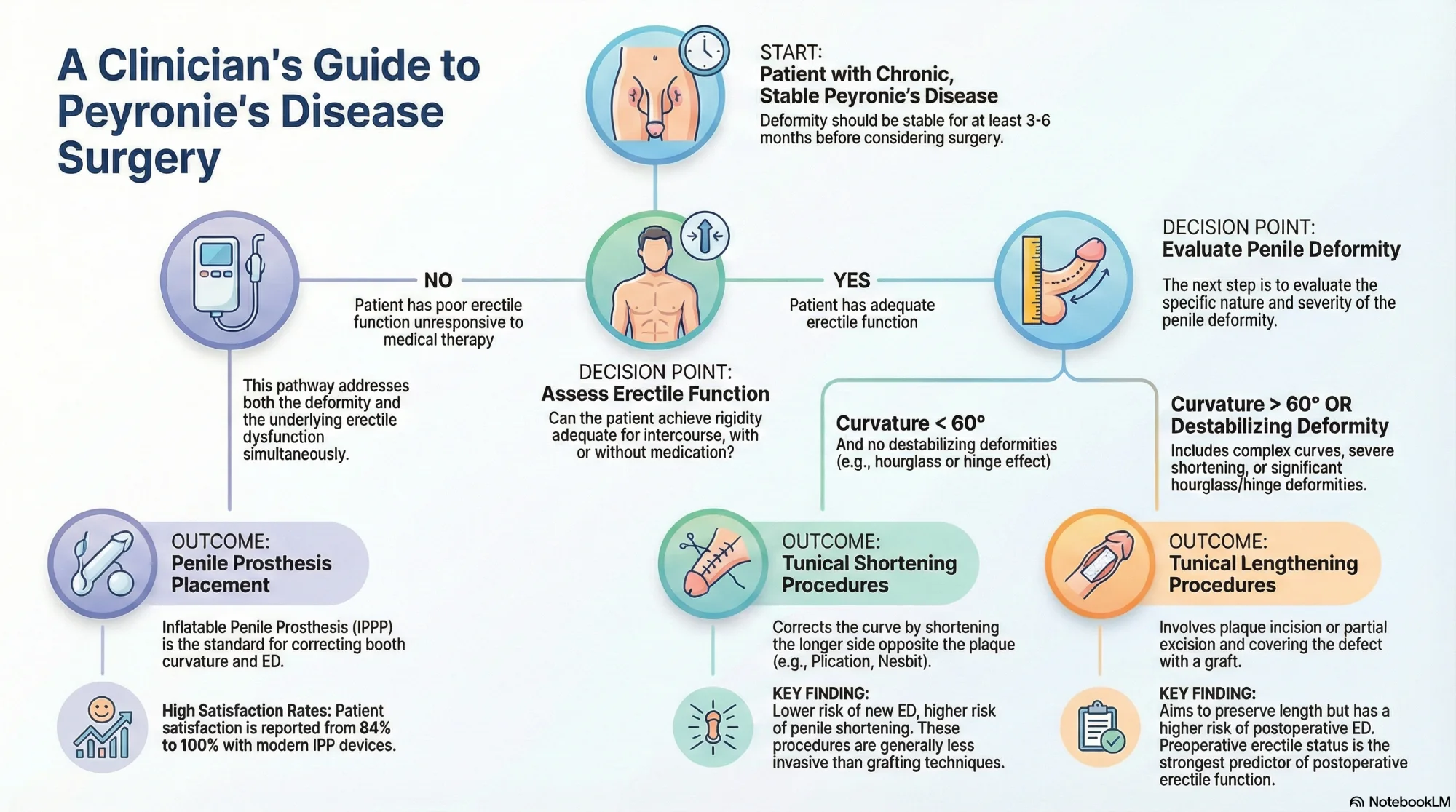
Surgery is the most effective option for men with stable disease and deformity that interferes with sexual function.
Dr. Vanni specializes in advanced surgical correction, including:
Tunical Plication
- Appropriate for men with good erectile function and less complex curvature
- Shortens the longer side of the penis to correct curvature
Plaque Incision or Excision with Grafting
- Used for more severe curvature, significant deformity, or hourglass narrowing
- Preserves penile length while correcting curvature
- Requires careful patient selection and surgical expertise
Penile Prosthesis Surgery
- Indicated for men with Peyronie's disease and significant erectile dysfunction
- Corrects curvature while restoring rigidity
- May include adjunctive straightening maneuvers
The choice of procedure depends on anatomy, erectile function, goals, and risk tolerance, and should be guided by an experienced reconstructive surgeon.
Why See a Reconstructive Urologist for Peyronie's Disease?
Surgical treatment of Peyronie's disease requires:
- Precise deformity assessment
- Expertise in multiple reconstructive techniques
- Clear counseling regarding tradeoffs (length, rigidity, sensation)
High-volume reconstructive experience is especially important in complex deformities, redo surgery, or cases combined with erectile dysfunction.
Dr. Vanni's approach emphasizes functional outcomes, durability, and patient-centered decision-making, with careful attention to both physical and quality-of-life considerations.
National Referral Center for Complex Peyronie's Disease
Men with severe curvature, complex deformity, or prior failed treatment are referred nationally to Dr. Vanni for expert evaluation and definitive management. He works collaboratively with referring physicians to ensure comprehensive care and long-term follow-up.
Have Questions About Peyronie's Disease?
Get answers to the most common questions about peyronie's disease treatment, surgery, and recovery.
View Frequently Asked QuestionsTreatment decisions for Peyronie's disease are guided by peer-reviewed research and evidence-based surgical guidelines developed through multicenter studies.
Treatment Outcomes at a Glance
Success Rate
90–95% functionally straight with surgical treatment
Surgery Duration
Outpatient surgery taking 1–3 hours depending on procedure
Recovery
Full healing typically in 4–8 weeks




Schedule a Consultation
If Peyronie's disease is affecting your sexual function or quality of life, expert evaluation can help determine the most appropriate treatment options.
Preparing for Your Procedure?
Access detailed pre-operative and post-operative instructions to help you prepare for surgery and recover successfully.
View Pre-Op & Post-Op Instructions →Questions about your care? Call (781) 744-8762
Related Conditions
You may also want to learn about these related urologic conditions: