Home › Peyronie's Disease › 3D Surgical Atlas
Peyronie’s Disease in 3D: An Interactive Surgical Atlas
By Alex J. Vanni, MD, FACS — Director, Center for Reconstructive Urologic Surgery, Lahey Clinic
One plaque, one 60-degree curve, and four ways of straightening it. Rotate the model to see how a dorsal plaque bends the erect penis upward, then step through each treatment to see which side it shortens or lengthens, and why.
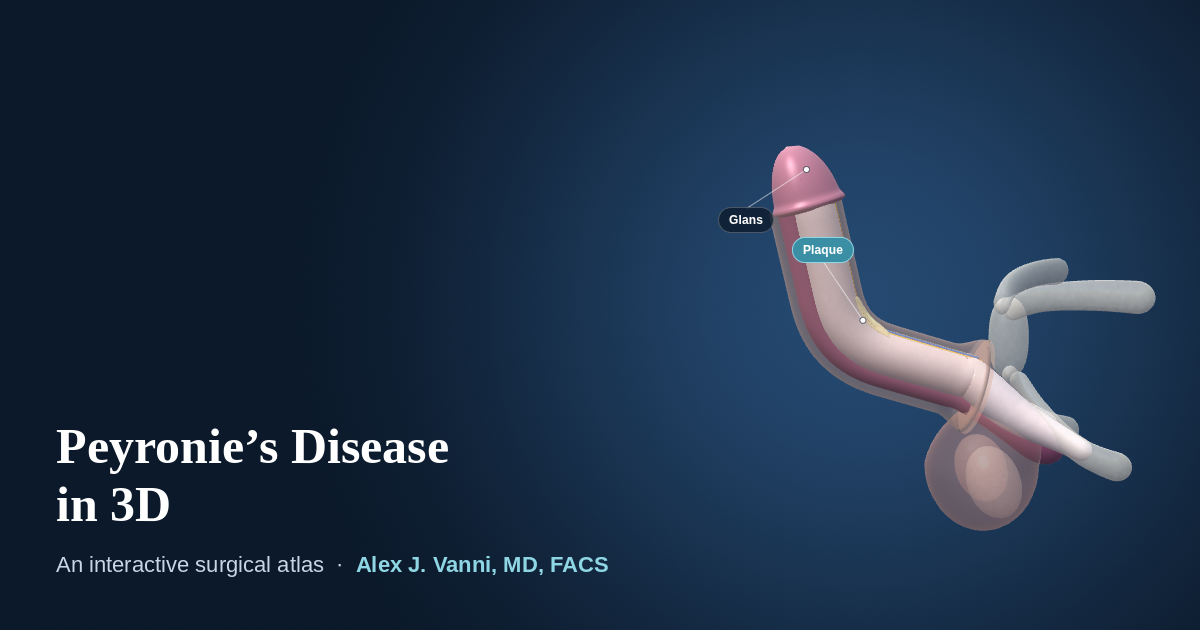
The interactive model needs WebGL, which is not available in this browser. The anatomy and each procedure are described in full below.
Schematic teaching model. Anatomy is simplified and not to scale in every detail. For education only, not for clinical use.
How to Use the Atlas
- Look aroundDrag to rotate. Pinch, or hold Ctrl and scroll, to zoom. Shift-drag moves the model.
- Look insideCutaway opens the model through one erectile chamber, so the plaque can be seen in section on the tunica.
- Ask what something isClick any structure for its name and what it has to do with Peyronie’s disease.
What the Five Views Show
-
The curvature
Peyronie’s disease is a scar, or plaque, in the tunica albuginea, the tough sheath around the erectile chambers. The plaque does not stretch during an erection, so the penis bends toward it. Here the plaque is on the top (dorsal) surface and the curve is 60 degrees upward.
-
Collagenase injection with modeling (Xiaflex)
An enzyme that breaks down collagen is injected directly into the plaque, and the penis is then gently stretched in the opposite direction, which is called modeling. It can reduce curvature in selected men: those with stable disease, a curve in a treatable range and good erections. Each treatment cycle is two injections given 1 to 3 days apart, followed by modeling. Cycles are about 6 weeks apart, up to a maximum of four cycles (eight injections). It does not remove the plaque.
-
Plication (modified 16-dot technique)
Sixteen small marks are placed on the side opposite the curve, here the underside, and permanent sutures passed through them are tied to gather that longer side until the penis is straight. It is the most straightforward operation with the shortest recovery, and it accepts some loss of length as the tradeoff.
-
Partial plaque excision with grafting
The nerves and vessels on top of the penis are carefully lifted, part of the plaque is removed, and the shorter side is allowed to lengthen until the penis is straight. The opening in the tunica is covered with a graft of processed pericardium (Tutoplast). Grafting preserves length but carries a higher risk of affecting erections than plication.
-
Penile implant with grafting
For men with Peyronie’s disease and erectile dysfunction, an inflatable implant restores rigidity and corrects much of the curve. Any curvature that remains is released with an incision through the plaque, and the opening is covered with a graft. Implant placement combined with straightening achieves over 90% satisfaction.
Surgical correction achieves significant straightening in approximately 85 to 95% of cases, depending on the procedure performed. The goal is functional straightness, and a small residual curve can remain. See recovery after Peyronie’s surgery, choosing among the treatment options and the Peyronie’s disease FAQs.
The Structures Involved
- Tunica albuginea
- The tough, stretchy sheath around each erectile chamber. A Peyronie’s plaque is scar within it.
- Plaque
- A firm scar that does not stretch during an erection. The penis bends toward the side where it sits.
- Corpora cavernosa
- The paired erectile chambers. They fill with blood during an erection, and an implant cylinder can be placed in each one.
- Dorsal nerves and vessels
- Run along the top of the penis and carry sensation. With a dorsal plaque they lie directly over it, so they are lifted and protected during grafting.
About This Model
The atlas is a schematic built for teaching. Shapes and proportions are simplified, the plaque and curve are a constructed example rather than a real patient, and no two cases of Peyronie’s disease are alike. It is not a substitute for an individual evaluation, which includes an assessment of the curvature, the plaque, penile length and erectile function.
This page is for educational purposes and is not a substitute for an individual medical evaluation. Reviewed by Alex J. Vanni, MD, FACS. Last updated September 19, 2026.
Questions About Peyronie’s Disease?
Dr. Vanni evaluates and treats men with Peyronie’s disease from across New England and nationwide, including complex and revision cases.
Call (781) 744-8762 or learn more about Peyronie’s disease treatment.