Home › Bladder Neck Contracture › 3D Surgical Atlas
Bladder Neck Contracture in 3D: An Interactive Surgical Atlas
By Alex J. Vanni, MD, FACS — Director, Center for Reconstructive Urologic Surgery, Lahey Clinic
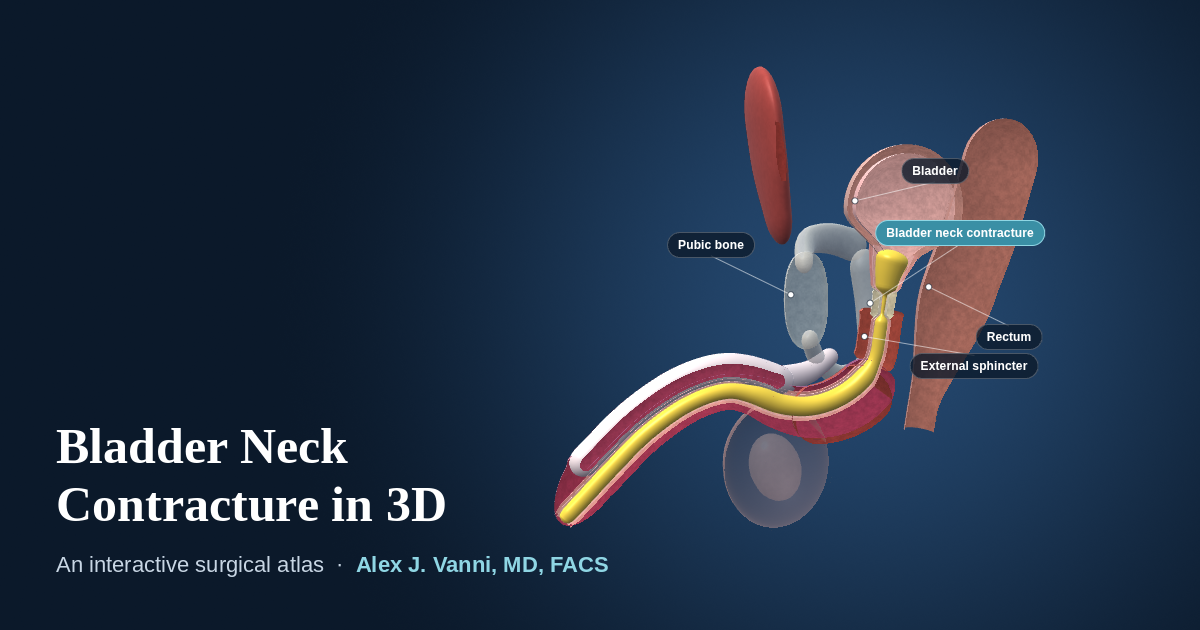
One scarred bladder neck, and the path from a scope to reconstruction. Rotate the model, open it in cutaway to see the narrowing where the bladder meets the urethra, then step through each treatment in the order it is usually considered.
The interactive model needs WebGL, which is not available in this browser. The anatomy and each procedure are described in full below.
Schematic teaching model. Anatomy is simplified and not to scale in every detail. For education only, not for clinical use.
How to Use the Atlas
- Look aroundDrag to rotate. Pinch, or hold Ctrl and scroll, to zoom. Shift-drag moves the model.
- Look insideCutaway opens the model along the midline to show the narrowed channel between the bladder and the urethra.
- Ask what something isClick any structure for its name and what it has to do with a bladder neck contracture.
What the Four Views Show
-
The contracture
A bladder neck contracture is scar that narrows the opening where the bladder drains into the urethra. It most often follows prostate surgery: after radical prostatectomy it forms at the join between the bladder and the urethra, and after transurethral prostate surgery, such as TURP or laser procedures, it forms at the bladder neck itself. The model shows the form after prostatectomy. It causes a weak stream, straining and incomplete emptying.
-
Cold-knife incision with mitomycin C
Through a scope passed up the urethra, the scar is cut with a cold knife to open the channel, and mitomycin C, a medication that slows scar formation, is injected into the incisions. Success with endoscopic treatment ranges from 76 to 94%, depending on whether there has been prior pelvic radiation.
-
Robotic Y-V plasty
When the bladder neck is completely closed off, or endoscopic treatment has failed, the bladder neck is rebuilt robotically. A Y-shaped incision is made through the narrowed segment, and a V-shaped flap of healthy bladder is advanced into the opening, widening it with living tissue. In experienced hands, robotic reconstruction succeeds in 75 to 90% of cases, depending on complexity.
-
Staged artificial urinary sphincter
Opening a bladder neck contracture can leave stress incontinence, because the sphincter has often been weakened by the earlier treatment. If it does, an artificial urinary sphincter is placed in a separate, later operation, once the bladder neck has healed and stays open.
A catheter rests in place after each procedure while the tissues heal. See the bladder neck contracture FAQs, and the male incontinence atlas for how the artificial urinary sphincter works.
The Structures Involved
- Bladder neck
- The funnel-shaped outlet of the bladder. After prostate removal it is sewn directly to the urethra.
- Vesicourethral anastomosis
- The join between the bladder and the urethra after the prostate is removed. This is where the scar of a contracture usually forms.
- External urethral sphincter
- The muscle that provides urinary control, just below the bladder neck. Treatment is planned to protect it, but it is often already weakened.
- Bulbar urethra
- The part of the urethra in the perineum, farther from the bladder. An artificial urinary sphincter cuff is placed here, away from the reconstructed bladder neck.
About This Model
The atlas is a schematic built for teaching. Shapes and proportions are simplified, the contracture is a constructed example rather than a real patient, and no two contractures are alike. It is not a substitute for an individual evaluation, which usually includes cystoscopy and imaging of the bladder neck and urethra.
This page is for educational purposes and is not a substitute for an individual medical evaluation. Reviewed by Alex J. Vanni, MD, FACS. Last updated September 19, 2026.
Questions About a Bladder Neck Contracture?
Dr. Vanni treats primary, recurrent and radiation-associated bladder neck contractures for patients from across New England and nationwide.
Call (781) 744-8762 or learn more about bladder neck contracture treatment.