Home › Male Stress Incontinence › 3D Surgical Atlas
Male Stress Incontinence in 3D: An Interactive Surgical Atlas
By Alex J. Vanni, MD, FACS — Director, Center for Reconstructive Urologic Surgery, Lahey Clinic
One weakened sphincter, and the two operations that restore control. Rotate the model, open it in cutaway to see the sphincter around the urethra, then step through the male sling and the artificial urinary sphincter to see how each keeps you dry.
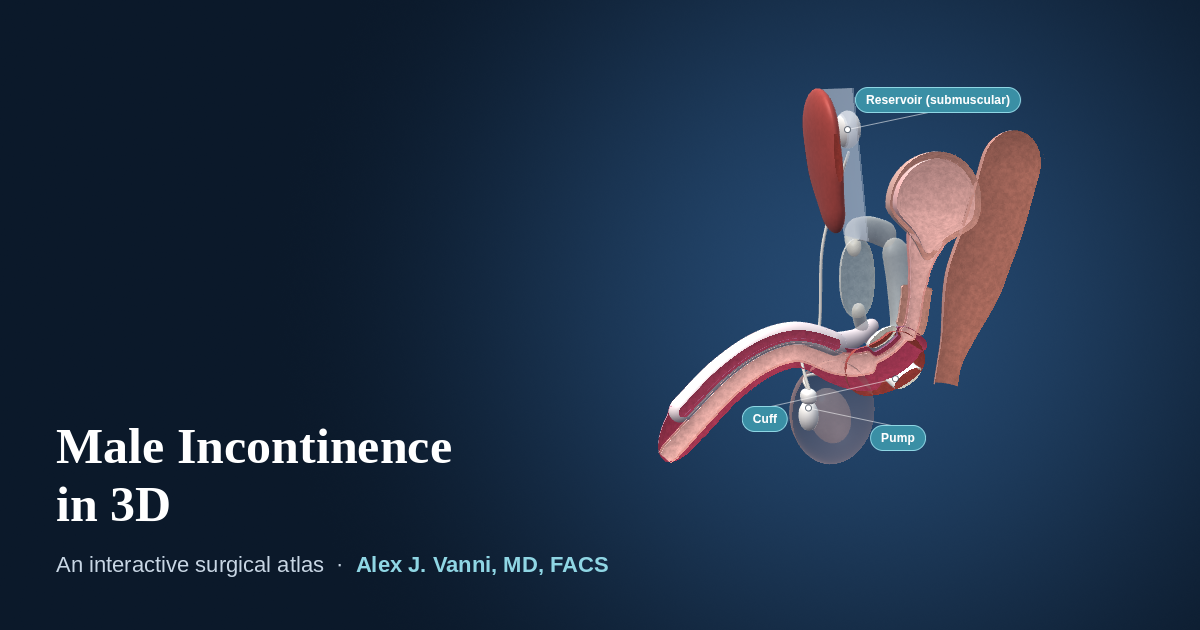
The interactive model needs WebGL, which is not available in this browser. The anatomy and each procedure are described in full below.
Schematic teaching model. Anatomy is simplified and not to scale in every detail. For education only, not for clinical use.
How to Use the Atlas
- Look aroundDrag to rotate. Pinch, or hold Ctrl and scroll, to zoom. Shift-drag moves the model.
- Look insideCutaway opens the model along the midline. Device only fades the body so the sling or the whole sphincter can be seen.
- Ask what something isClick any structure or device part for its name and what it does.
What the Three Views Show
-
The problem
After prostate removal, the external sphincter, the ring of muscle that keeps you dry, can be weakened. When pressure in the abdomen rises with a cough, a lift or standing up, urine leaks past it. This is stress urinary incontinence.
-
The male sling (AdVance XP)
A strip of soft mesh is placed beneath the bulbar urethra through a small incision in the perineum, and its arms pass through the openings in the pelvic bone on each side. Tensioned, it lifts and repositions the urethra so the remaining sphincter works better. There is nothing to operate. The sling works best in men without prior radiation who have mild leakage, wearing 2 or fewer pads per day.
-
The artificial urinary sphincter (AUS)
A fluid-filled cuff around the bulbar urethra holds it closed. To urinate, you squeeze a pump in the scrotum, which moves fluid out of the cuff into a reservoir placed beneath the abdominal wall muscles (submuscular). The cuff refills on its own within a few minutes. The AUS suits more severe leakage and men who have had radiation, and achieves significant or complete continence in approximately 94% of patients.
The choice between a sling and an AUS depends mainly on whether there has been previous pelvic radiation and on the degree of incontinence. See recovery after a male sling, recovery after an AUS and the male incontinence FAQs.
The Structures Involved
- External urethral sphincter
- The ring of muscle around the membranous urethra that provides urinary control. It can be weakened by prostate surgery or radiation.
- Vesicourethral anastomosis
- Where the bladder was rejoined to the urethra after the prostate was removed.
- Bulbar urethra
- The part of the urethra in the perineum, surrounded by the spongy bulb. Both the sling and the AUS cuff sit here.
- Obturator foramen
- The large opening on each side of the pelvic bone. The arms of a transobturator sling pass through it.
About This Model
The atlas is a schematic built for teaching. Shapes and proportions are simplified, the devices are shown generically, and every man’s anatomy is different. It is not a substitute for an individual evaluation, which usually includes a pad assessment, a review of prior treatment including radiation, and often cystoscopy.
This page is for educational purposes and is not a substitute for an individual medical evaluation. Reviewed by Alex J. Vanni, MD, FACS. Last updated September 19, 2026.
Questions About Male Incontinence?
Dr. Vanni treats men with stress incontinence after prostate surgery or radiation from across New England and nationwide, including revision and complex cases.
Call (781) 744-8762 or learn more about male incontinence treatment.