Home › Penile Implants › 3D Surgical Atlas
Penile Implants in 3D: An Interactive Surgical Atlas
By Alex J. Vanni, MD, FACS — Director, Center for Reconstructive Urologic Surgery, Lahey Clinic
Two erectile chambers, and the two kinds of implant that restore rigidity inside them. Rotate the model, open it in cutaway to see a cylinder inside its chamber, then step through each procedure to see where every part goes and how it works.
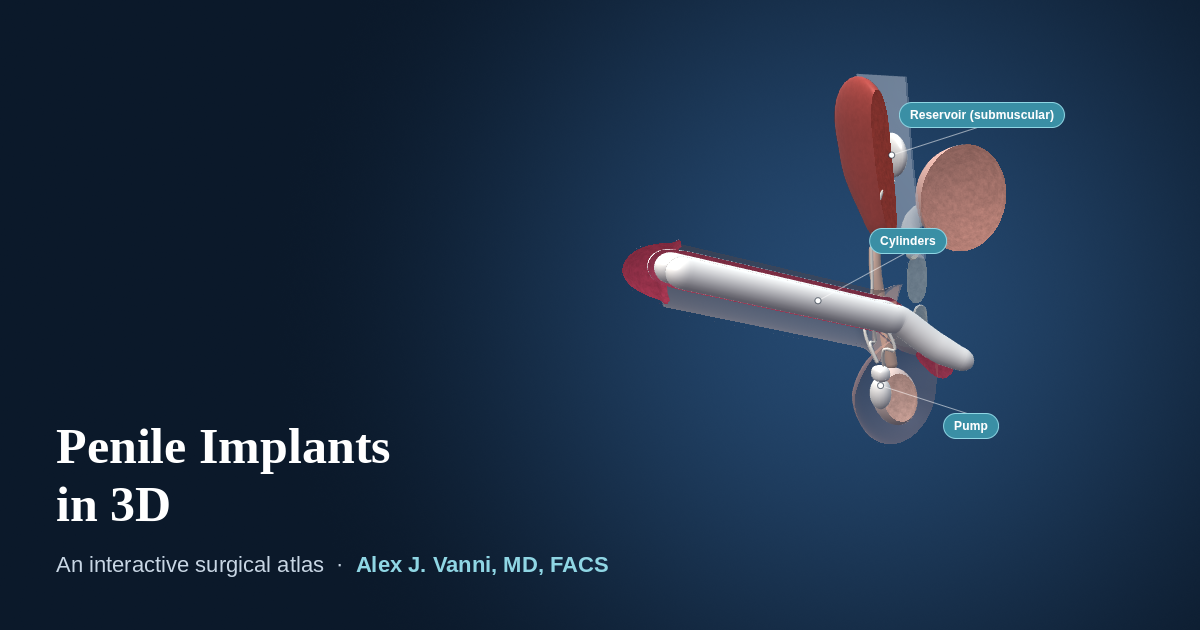
The interactive model needs WebGL, which is not available in this browser. The anatomy and each procedure are described in full below.
Schematic teaching model. Anatomy is simplified and not to scale in every detail. For education only, not for clinical use.
How to Use the Atlas
- Look aroundDrag to rotate. Pinch, or hold Ctrl and scroll, to zoom. Shift-drag moves the model.
- Look insideCutaway opens the model through one erectile chamber. Device only fades the body so the whole implant can be seen.
- Ask what something isClick any structure or implant part for its name and what it does.
What the Three Views Show
-
The anatomy
An erection happens when the two erectile chambers (corpora cavernosa) fill with blood and the tough sheath around them holds that blood under pressure. When erectile dysfunction has not responded to medications, injections or a vacuum device, an implant places the rigidity inside the chambers themselves.
-
The inflatable implant
A three-piece inflatable implant has two cylinders in the erectile chambers, a pump in the scrotum and a fluid reservoir. Dr. Vanni places all three through one small incision where the penis meets the scrotum (the penoscrotal approach) and positions the reservoir beneath the abdominal wall muscles (submuscular). Squeezing the pump fills the cylinders; pressing the release button empties them. With modern antibiotic-coated devices, infection rates are about 1 to 2%, and more than 90% of men are satisfied with the result.
-
The malleable implant
A malleable implant is two bendable rods, one in each chamber, with no pump or reservoir. The penis is always firm and is bent upward for intercourse and downward to conceal it. It is placed through the same penoscrotal incision.
The implant is left deflated while the tissues heal, and most men learn to use it at a visit 2 to 4 weeks after surgery. See recovery after a penile implant and the penile implant FAQs.
The Parts of an Inflatable Implant
- Cylinders
- Two cylinders, one in each erectile chamber. They fill with saline for an erection and empty to return the penis to a soft state.
- Pump
- Sits in the scrotum between the testes, where it is easy to find and squeeze. It also carries the release button.
- Reservoir
- Holds the saline when the implant is deflated. Dr. Vanni places it in a submuscular position, behind the abdominal wall muscles.
- Tubing
- Connects the three parts into a closed, fluid-filled system beneath the skin. Nothing is visible from the outside.
About This Model
The atlas is a schematic built for teaching. Shapes and proportions are simplified, the implant is shown generically rather than as any particular brand, and every man’s anatomy is different. It is not a substitute for an individual evaluation.
This page is for educational purposes and is not a substitute for an individual medical evaluation. Reviewed by Alex J. Vanni, MD, FACS. Last updated September 19, 2026.
Questions About a Penile Implant?
Dr. Vanni performs primary and complex penile implant surgery for patients from across New England and nationwide, including men with prior pelvic surgery, radiation or Peyronie’s disease.
Call (781) 744-8762 or learn more about penile implant surgery.